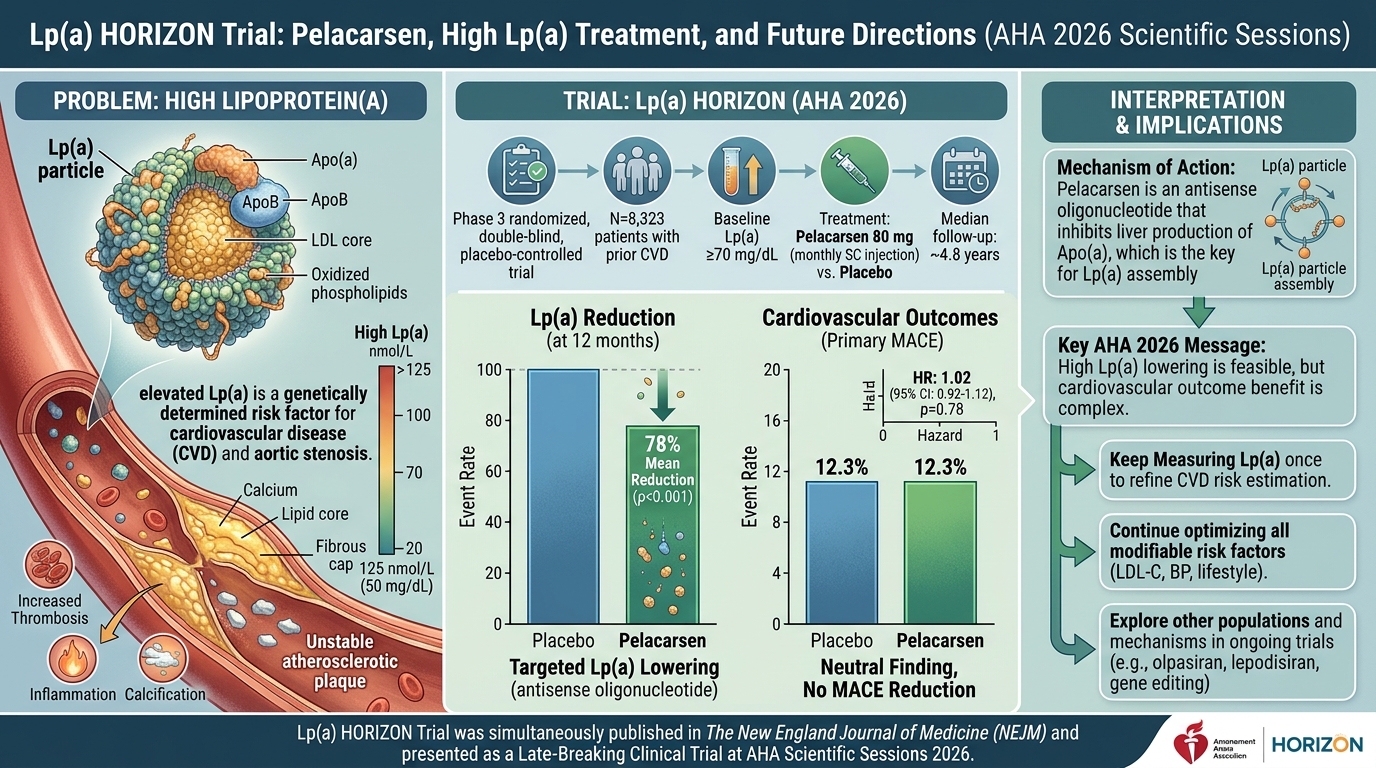
For years, lipoprotein(a), or Lp(a), has been called the “hidden” cholesterol, an inherited risk factor that diet and exercise barely touch. Scientists hoped that drugs that sharply lower Lp(a) would finally protect the roughly one in five people who carry high levels. On November 7, 2026, the first big test of that idea came back with a surprising result.
What the trial tested
The Lp(a) HORIZON trial enrolled more than 8,300 adults with established cardiovascular disease and high Lp(a) at 797 sites in 42 countries. Participants received either a monthly injection of pelacarsen, an antisense drug that blocks Lp(a) production, or a placebo, on top of standard care (GPCardio summary).
The drug worked on the number, not on the outcome
Pelacarsen did exactly what it was designed to do on paper. After 12 months, Lp(a) levels fell by 78.4% in the treatment group compared with 3.2% on placebo (Cleveland Clinic).
But over a median of 4.7 years, heart attacks, strokes, urgent heart procedures and cardiovascular deaths occurred in 12.3% of patients on pelacarsen and 12.1% on placebo, essentially no difference (Healio). Even patients with the highest Lp(a) levels saw no benefit. Deaths from any cause were also similar, at 5.7% versus 5.9% (HCPLive).
The drug also had downsides. Flu-like reactions, injection-site reactions and stopping treatment because of side effects were all more common with pelacarsen (GPCardio).
A tough week for “fix the biomarker” drugs
HORIZON was not the only disappointment at the American Heart Association’s meeting. The ZEUS trial of ziltivekimab, an anti-inflammatory drug, also failed to reduce major cardiovascular events, and both results prompted debate about how new heart drugs should be tested (Cardiovascular Business).
Is Lp(a) still worth testing?
Yes. Lead investigator Dr. Steven Nissen stressed that the results apply only to this specific drug and to patients who already have heart disease (Medscape). Other Lp(a)-lowering drugs that work differently are still being tested. Current US guidelines continue to recommend a one-time Lp(a) blood test for all adults (National Lipid Association), because knowing your level helps you and your doctor manage other risk factors more aggressively.
What you can do now
- Ask your doctor whether you have had your Lp(a) measured.
- If it is high, focus on what is proven: controlling LDL cholesterol, blood pressure, blood sugar and not smoking.
- Do not expect a single “Lp(a) pill” soon. This trial shows that lowering a number is not the same as preventing a heart attack.
