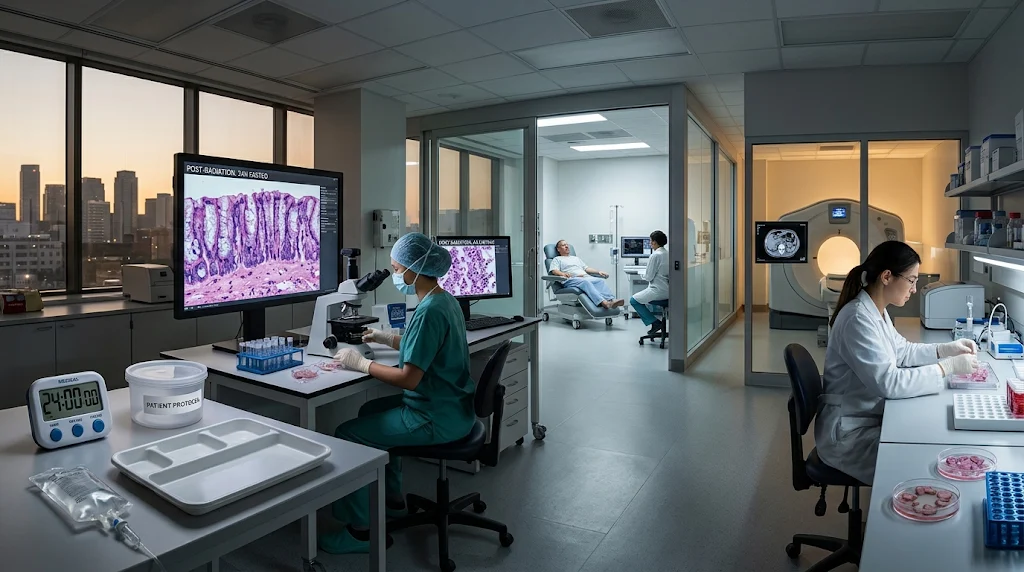
How a 24-Hour Fast Could Help the Gut Recover From Radiation
Radiation therapy for abdominal cancers, such as colorectal and pancreatic cancer, often damages the delicate lining of the small intestine, causing painful side effects. New research from The University of Texas MD Anderson Cancer Center suggests that a short fast, with help from one gut bacterium, could prepare the intestine to heal faster.
The key player: Akkermansia
In experiments on mice, fasting for 24 hours increased levels of a beneficial gut bacterium called Akkermansia muciniphila, or AKK, in the small intestine (MD Anderson). The study was published in the Proceedings of the National Academy of Sciences.
How it works
AKK produces a small molecule called propionate. Together with other changes triggered by fasting, propionate adds chemical tags to histones, the proteins that DNA is wrapped around. These tags unlock genes involved in tissue repair without changing the genetic code itself (ScienceDaily).
In effect, the fast “preloads” a group of intestinal cells with repair instructions. When radiation damage occurs, these cells expand and help rebuild the intestinal lining.
Proof that the bacterium matters
When researchers removed AKK from the gut, fasting lost its protective effect. The benefit returned only when AKK was put back alongside fasting, showing that both are needed (MD Anderson). In one experiment, only half of antibiotic-treated fasted mice survived high-dose radiation, but all survived when AKK was restored (bioRxiv preprint).
What it could mean for patients
Strict fasting is not suitable for every cancer patient, many of whom already struggle to maintain their weight. The bigger promise is that understanding this pathway could lead to treatments based on the bacterium or its molecules that protect healthy tissue without the need to fast (ScienceDaily).
Important caveat
This research was done in mice. Further studies are needed to confirm whether the same mechanism works in humans and whether it can safely improve outcomes for people receiving radiation therapy (ScienceDaily).
The takeaway
If you are having cancer treatment, do not start fasting on your own. Talk to your oncology team first. But keep an eye on this area: the gut microbiome is becoming one of the most exciting frontiers in reducing the side effects of cancer therapy.